
Seals are the least specified and most consequential part of a cylinder. A datasheet will give you bore, rod, stroke and pressure and leave the seal material as an unstated default, which means the default is whatever the factory had on the shelf. When the cylinder fails, it fails there.
A seal set is five parts, not one
On a double-acting cylinder the sealing system is:
- Piston seal — separates the two chambers. Leakage here shows up as drift, not as external wetness.
- Rod seal — the primary gland seal. This is the one that weeps.
- Wiper or scraper — keeps contamination out. Its failure causes the rod seal failure that gets blamed on the rod seal.
- Wear bands — not seals at all, but they carry the side load so the seals do not have to. Under-specifying wear bands is the most common cause of premature rod seal wear.
- Static seals and backup rings — O-rings on the end caps, and anti-extrusion rings behind the dynamic seals at pressure.
Specifying the first two and ignoring the rest produces a cylinder with good seals and a short life.
Material is chosen against the fluid first
The common mistake is to choose a seal material by temperature. Temperature matters, but the fluid decides compatibility, and a material that is incompatible with the fluid fails regardless of temperature.
| Material | Typical range | Good with | Avoid with |
|---|---|---|---|
| NBR (nitrile) | −30 to 100 °C | Mineral oil, HFC water-glycol at reduced rating | Phosphate ester, hot water |
| PU (polyurethane) | −30 to 90 °C | Mineral oil, high pressure, abrasive duty | Water above 60 °C (hydrolysis) |
| HNBR | −30 to 140 °C | Mineral oil at temperature, sour service | Cost-sensitive jobs |
| FKM (Viton) | −20 to 200 °C | Mineral oil, many chemicals, high temperature | Hot water, steam, some phosphate esters |
| EPDM | −40 to 130 °C | Phosphate ester, water-glycol | Any mineral oil — it swells and disintegrates |
| PTFE | −70 to 200 °C | Almost everything; needs an energiser | Dry running, poor groove finish |
The EPDM row is the one that causes expensive failures. It is the correct choice for a phosphate ester fire-resistant fluid and it is catastrophic in mineral oil. If a cylinder is built for a steel mill on HFD fluid and later moved to a machine running mineral oil without a seal change, the seals dissolve. The cylinder is not defective; the specification was.
This is why the fluid belongs in the enquiry, not just the temperature.
Extrusion: the arithmetic behind backup rings
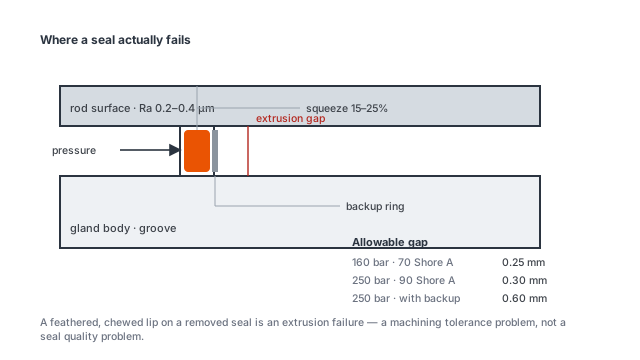
Under pressure, an elastomeric seal is pushed into any gap it can reach. If the gap is too large for the material hardness and the pressure, the seal is nibbled away at the edge — you see a feathered, chewed lip on a removed seal.
The allowable diametral clearance falls as pressure rises and rises with hardness. Working figures:
| Pressure | 70 Shore A | 80 Shore A | 90 Shore A | With backup ring |
|---|---|---|---|---|
| 100 bar | 0.40 mm | 0.50 mm | 0.60 mm | 0.80 mm |
| 160 bar | 0.25 mm | 0.35 mm | 0.45 mm | 0.70 mm |
| 250 bar | 0.15 mm | 0.20 mm | 0.30 mm | 0.60 mm |
| 400 bar | — | 0.10 mm | 0.15 mm | 0.45 mm |
Two things follow. First, at 250 bar and above, a 70 Shore seal without a backup ring is not a specification, it is a failure waiting to happen. Second, the gap is a machining tolerance, which means extrusion resistance is bought at the machine tool as well as at the seal supplier. A cylinder whose gland clearance is held to 0.3 mm can run a softer seal at higher pressure than one held to 0.6 mm.
Pressure spikes matter here too. A seal that survives steady 160 bar can extrude during a 260 bar transient, which is another reason shock loading belongs in the duty specification.
Life is sliding distance, not years
Seals wear by rubbing. The useful measure is total sliding distance, and published life figures for hydraulic cylinder seals are usually in the range of 100 to 500 km of travel, with well-specified industrial cylinders reaching more.
Take a cylinder on a 500 mm stroke, running 20 cycles an hour, 8 hours a day, 250 days a year. Each cycle is 1.0 m of travel if you count extension and retraction, so:
20 × 8 × 250 = 40,000 cycles a year, at 1.0 m each = 40 km per year
At a 200 km life figure, that is five years. At 100 km, it is two and a half. Raise the cycle rate to 60 an hour and the same cylinder lasts under two years — same seals, same oil, same pressure, three times the wear.
This is the calculation that connects a duty cycle to a maintenance interval, and it is why the question “how long do your seals last” has no answer without the cycle rate.
The failures and what they mean
Reading a removed seal is faster than any analysis.
- Feathered or chewed edge — extrusion. Gap too large, hardness too low, or pressure spikes not accounted for.
- Flat worn face on one side only — side load. The wear bands are not carrying it, or the cylinder is misaligned, or the rod is bent.
- Hard, cracked, permanently flattened — compression set from overheating. Check oil temperature at the gland, which runs 10 to 20 °C above tank temperature.
- Soft, sticky, crumbling — hydrolysis, and it is almost always polyurethane in hot oil with water in it. Fix the water, not just the seal.
- Scored in a straight line along the rod axis — contamination embedded in the wiper. The rod seal is a victim.
- Rod seal flipped or extruded with the lip inverted — trapped pressure between two seals in series. In a two-seal gland with no vent, back pressure builds between them and destroys the primary seal from behind. The fix is a drain path between the seals.
That last one is a design error that looks like a seal quality problem, and it recurs on every rebuild until the groove is changed.
Grooves and surface finish
A seal can be correct in material and still fail in the wrong groove.
- Squeeze: radial squeeze of 15 to 25 % of the section for a static O-ring, less for dynamic. Too little and it leaks at low pressure; too much and it overheats and wears.
- Groove fill: leave room for thermal expansion. A groove filled completely will extrude the seal as soon as the oil warms up.
- Surface finish: the sliding counterface should be Ra 0.2 to 0.4 µm. Rougher cuts the seal; smoother carries no oil film and the seal runs dry on the first stroke after a standstill. Groove surfaces can be to Ra 1.6 µm.
- Lead-in chamfers: a sharp edge at assembly cuts the seal before it ever works.
What to put in the specification
- Fluid type, explicitly — mineral oil, water-glycol, phosphate ester, or bio-oil. Not “hydraulic oil.”
- Maximum oil temperature at the cylinder, not in the tank.
- Peak pressure including transients, not just the relief setting.
- Cycle rate and hours per year, so life can be estimated in sliding distance.
- Environment: dry dust, washdown, salt spray, subsea. This drives the wiper and, in marine service, the rod material.
- Any consequence of failure. If a leak stops a production line or contaminates a product, specify two seals in series with a vented annulus, and accept the cost.
None of this appears on a standard cylinder datasheet, which is why a cylinder that matches every printed number can still be the wrong cylinder. The seal specification is the part that has to be asked for.