
Tools
The four calculations that decide a hydraulic specification
Force, speed, power and units. Every hydraulic sizing argument comes back to these four, and three of them are routinely done with the wrong number. Each tool shows the formula it uses, so you can check the arithmetic instead of trusting the box.
Cylinder force
Bore, rod and pressure to push force, pull force and area ratio. Shows the rod-side loss that most tables skip.
Open tool →SizingCylinder speed
Flow to extension and retraction speed, stroke time, and oil volume per cycle.
Open tool →Power unitsHydraulic power
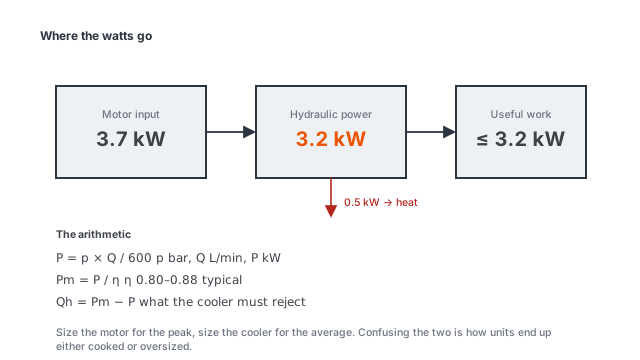
Pressure and flow to hydraulic kW, motor size at a real efficiency, and the heat left over.
Open tool →ReferenceUnit converter
Pressure, flow, length, force, temperature and volume, with exact factors and the US/UK traps flagged.
Open tool →What these tools do not do
- They do not pick a cylinder for you. They give the arithmetic; the buckling check, the mounting and the duty cycle still have to be decided by somebody.
- They do not model losses. Real force is 5–10% below the theoretical figure from seal friction and back pressure.
- They do not store anything. No account, no cookies, nothing sent to a server — the numbers are computed in your browser.
Where the formulas come from
Force, area and speed are definitions, not opinions: F = p × A, v = Q / A. The unit factors use exact definitions where they exist (1 in = 25.4 mm, 1 bar = 100 000 Pa) rather than rounded textbook values. If a result here disagrees with another calculator, the other calculator is probably rounding a constant.
The reasoning behind each one is written up in theguides, including the cases where the calculation gives a number that is technically correct and practically wrong.