
Tools
Hydraulic power unit calculator
Pressure times flow is the hydraulic power the circuit delivers. Motor size and heat load both follow from it, and both are what decide whether a power unit needs a cooler.
Result
- Hydraulic power
- — kW
- = — hp
- Motor shaft power
- — kW
- Suggested motor size
- — kW
- Heat to reject
- — kW
- Current at 24 V DC
- — A
Current assumes 90% motor efficiency and 24 V at the motor terminals. Use it to size cable and fusing, not to pick a battery.
Why the motor is always bigger than the hydraulic power
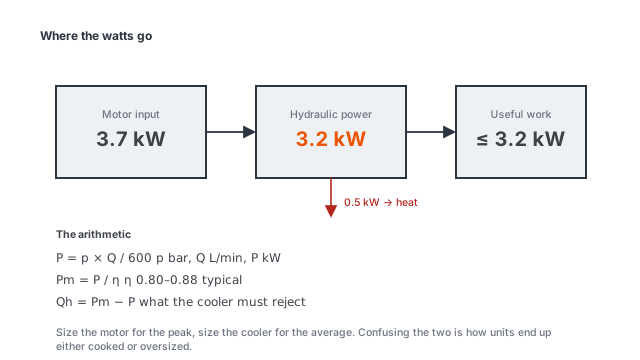
Pressure times flow gives the power that reaches the oil. The motor has to supply more than that, because the pump does not convert shaft power to hydraulic power for free. At 85% overall efficiency, a 3.2 kW hydraulic duty needs a 3.7 kW motor, and the 0.5 kW difference becomes heat in the oil.
That heat is why a continuous-duty power unit needs a cooler and an intermittent one can live without it. A 24 V DC unit on a tipping body runs for 20 seconds at a time and rejects its heat between cycles; a unit running all day has nowhere to put it. Seereservoir sizing and heat rejectionfor the tank-versus-cooler calculation.
The 24 V current figure is the one that catches people out. A few kilowatts at 24 V is well over 100 A, which sets the cable size, the contactor rating and the alternator requirement on a vehicle installation — not the cylinder.