
Tools
Hydraulic cylinder force calculator
Enter bore, rod diameter and working pressure. The calculator returns the theoretical push and pull force, the effective areas, and the ratio between them — which is also the speed ratio on a fixed-flow circuit.
Result
- Push force
- — kN
- = — t
- Pull force (rod side)
- — kN
- = — t
- Piston area
- — cm²
- Annulus area (rod side)
- — cm²
- Area ratio (push : pull)
- — : 1
- Rod / bore
- — %
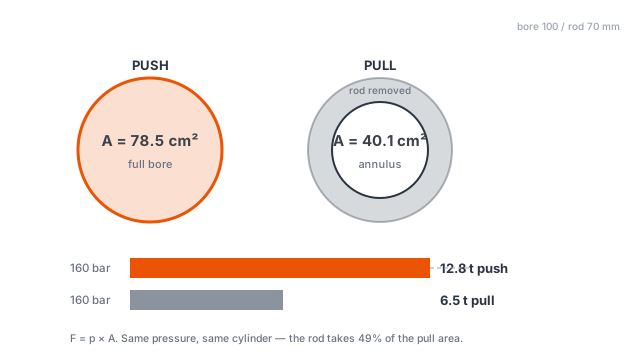
Reading the two numbers
A cylinder pushes with the full piston area and pulls with the piston area minus the rod. That is why the pull figure is always lower, and why the gap widens as the rod gets thicker. A 100/70 cylinder gives 12.8 t push and 6.5 t pull — the pull is barely half.
The same geometry sets speed. On a fixed-flow circuit, the rod side has less volume to fill, so retraction is faster by exactly the area ratio. If a machine needs equal speed in both directions, that is a through-rod cylinder or a flow-control decision, not something the calculator can fix.
Force is only half the sizing question. A long stroke cylinder can be limited by buckling well before it reaches its rated force — seecylinder force and bucklingfor the check that has to follow this one.