
A rigid dump truck and a dump trailer both tip a body backwards at about 48 degrees. The cylinder that does it is sized by the same arithmetic in both cases, and the answers come out different by roughly a factor of two. The difference is not tonnage — it is geometry, frame behaviour and how the machine gets loaded.
The arithmetic is identical
Take the load moment about the body hinge at the start of lift, when it is worst.
Rigid truck, 20 t payload. Body is 5.5 m long, payload centre of gravity sits about 2.5 m forward of the hinge. Moment = 20,000 × 9.81 × 2.5 = 490 kN·m.
The front-mount cylinder acts at a point about 3.5 m from the hinge. At the start of lift the cylinder is roughly 1.9 m long against a height offset of about 1.2 m, so the sine of the angle between the cylinder axis and the body floor is about 0.63. Effective lever arm = 3.5 × 0.63 = 2.2 m.
Required force = 490 / 2.2 = 223 kN, or 22.7 tonnes.
Dump trailer, 40 t payload. Body is 11 m, centre of gravity about 5 m from the hinge. Moment = 40,000 × 9.81 × 5 = 1,962 kN·m.
The cylinder acts 6 m from the hinge, with a longer body giving a better angle: 2.5 m cylinder against 1.5 m of offset gives a sine of 0.6, and an effective arm of 6 × 0.6 = 3.6 m.
Required force = 1,962 / 3.6 = 545 kN, or 55.6 tonnes.
Both are then satisfied with about the same margin: a 158 mm first stage at 160 bar gives 31.6 t for the truck (1.39 × required), and a 200 mm first stage at 250 bar gives 78.5 t for the trailer (1.41 × required). Same method, same margin, twice the cylinder.
So the specification divergence is not in the load case arithmetic. It is in the four things below.
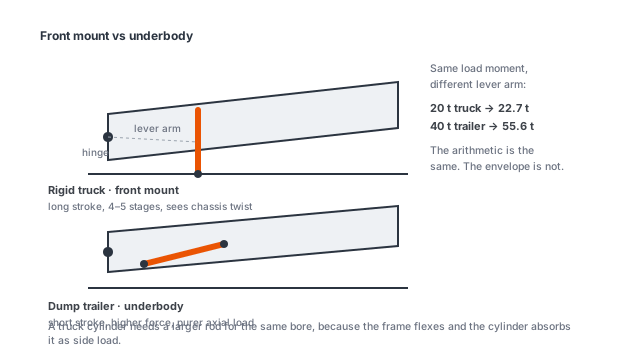
Frame twist: the difference nobody puts on a drawing
A rigid truck chassis is a ladder frame that twists. Cross a ditch at an angle with 20 t in the body and the two rails move relative to each other by tens of millimetres. The cylinder base is on the chassis; the rod end is on the body. The body is stiff, so the twist goes into the cylinder as side load.
This is why truck cylinders carry a larger rod and a longer bearing than the pure axial load requires. The rod is sized by bending, not by column load. It is also why the mounting eyes on truck cylinders wear: the pins are trying to accommodate a misalignment that the frame generates continuously, not occasionally.
A trailer being tipped is normally standing on its own legs or on the tractor’s fifth wheel with the trailer frame taking the load in a straight line. Twist at the cylinder mounts is small. Trailer cylinders can be specified closer to their pure axial rating, and they wear less at the pins.
The practical consequence: do not move a cylinder design from a trailer application to a truck application without increasing rod diameter. The bore is right; the rod is not.
Installed length versus stroke: where stages come from
A rigid truck has a cab behind the engine and a body behind that. The space available for a front-mount cylinder, from its lower pivot to the underside of the body, is short — often 1.8 to 2.2 m. The stroke needed is 4 m or more. The ratio of extended length to retracted length is over 3:1, which forces a multistage design, typically three to five stages.
A trailer has the whole length of the chassis to work with and no cab in the way. A front-mount cylinder can be longer when retracted, which means fewer stages for the same stroke, and fewer stages means a larger smallest stage, which means the force at the top of the lift does not fall off as sharply.
Fewer stages is generally better mechanically. Every stage is another bearing, another seal set and another place for contamination to enter. Trailers get away with three or four stages where a truck of the same stroke needs five, purely because of the space behind the cab.
Oil volume and lift time
Volume is the sum of each stage’s area times its own travel.
For the truck, three stages of 158 / 136 / 115 mm at 1,400 mm each: areas 196 / 145 / 104 cm², so volume = (196 + 145 + 104) × 140 = 62.3 litres. At 30 seconds of lift time that needs 125 L/min at the cylinder, on average.
For the trailer, five stages of 200 / 175 / 150 / 127 / 105 mm at 1,200 mm each: areas 314 / 241 / 177 / 127 / 87 cm², giving 113.5 litres. At 60 seconds that is 113 L/min — a similar pump, twice the time.
Trailers tip slower, and it is worth knowing why before anybody promises a lift time: it is volume, not weakness. If you want a 40-second lift on a 113-litre cylinder you need 170 L/min, which means a bigger PTO, a bigger pump and a bigger return line, and the return line is usually what gets forgotten.
Stability: the trailer’s real problem
A truck tips on its suspension, with a comparatively low centre of gravity and a short body. Material that sticks and then releases produces a jolt, and the truck absorbs it.
A trailer is a long beam standing on a pivot at one end and a tractor at the other. The centre of gravity rises much higher at full lift, and the whole assembly is sensitive to cross-slope. The documented failure mode is a trailer going over sideways with 40 t of wet sand half out, on ground that looked flat.
This changes what the cylinder circuit must do:
- Load-holding is mandatory. A hose failure at full lift must not drop the body. A pilot-operated check valve at the cylinder, not at the valve bank, is the correct place for it.
- Lowering must be controlled. A trailer body coming down under its own weight can generate flow the pump never produced. The return side needs a counterbalance or a controlled orifice, sized for the lowering flow, not for the lifting flow.
- Two-stage dumping helps. Some operators specify a two-speed circuit: fast to the point where the load starts moving, then slow. It is a control decision, not a cylinder decision, and it belongs in the specification conversation.
The truck circuit needs less of this. It still deserves a load-holding check, but the consequence of a failure is smaller.
How each one gets loaded
The loading method is a design input that is almost never written down, and it differs systematically between the two machines.
A rigid truck is usually loaded by an excavator or a wheel loader, bucket by bucket. Each bucket arrives with vertical velocity and lands on a body that may already have 15 t in it. The resulting pressure spike is not the steady load; on a badly damped circuit it can reach 1.5 times the relief setting for a few milliseconds. Cylinders for truck service need that transient in the design pressure, not in a footnote.
A trailer is more often loaded from a hopper, a conveyor or a stockpile face, which is more continuous and more likely to be off-centre. The problem is not the spike, it is the asymmetric load: 40 t sitting 300 mm left of the centreline puts a bending moment into a cylinder that was specified for axial load only.
Both are real. They are different real.
What this means for the specification
| Rigid dump truck | Dump trailer | |
|---|---|---|
| Dominant sizing input | Frame twist and installed length | Payload moment and stability |
| Typical stages | 4 to 5 (space behind cab) | 3 to 4 (chassis length available) |
| Rod sizing driver | Bending from chassis flex | Axial load and buckling |
| Pressure transient | Shock from loader buckets | Sustained off-centre load |
| Circuit priority | Damping and cushioning | Load holding and controlled lowering |
| Typical lift time | 20 to 30 s | 45 to 70 s |
The cylinder that is right for one is usually installable on the other and wrong on it. If you run both in a fleet and want one spare, buy the truck cylinder — the larger rod survives the trailer duty, while the reverse is not true.