
A cylinder datasheet tells you what the supplier claims. It is the least useful document in a first-order decision, because every supplier in every country can produce the same PDF. What separates factories is what they can show you about the unit they are about to ship.
This page does not describe any supplier, including us. It is a checklist you can take to any factory visit, video audit or first-order negotiation, and it is ordered by how much information each item gives you per minute spent.
Why the rating is the wrong thing to check first
Bore, stroke and pressure ratings are the three numbers every buyer checks, and they are the three numbers that never differ between a good factory and a bad one. Both buy the same tube, the same bar and the same seal kits. What differs is what happens between receiving the material and shipping the cylinder.
Two failure modes dominate first-order problems, and neither is visible on a datasheet:
- Barrel and weld integrity under pressure cycling. A barrel that passes a static test at 1.5 × working pressure will still crack at the base weld after a few thousand cycles if the weld penetration is shallow or the stress relief was skipped.
- Rod seal life. Two cylinders with the same seal part number can differ by a factor of five in service life, and the difference is rod surface finish, gland concentricity and assembly cleanliness — none of which appears on a spec sheet.
So the productive questions are about process and measurement, not about ratings.
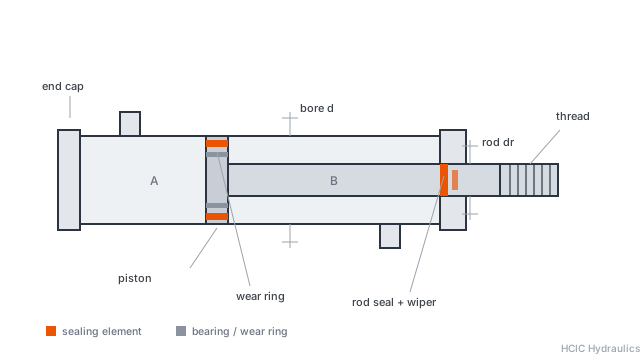
Eight questions to ask, with what a real answer sounds like
1. What is your test pressure and how long do you hold it? The standard answer is 1.5 × rated working pressure, held for a defined time. Ask for the hold time. A factory that holds 30 seconds and one that holds 5 minutes are not doing the same test. Ask whether the record is per-unit or per-batch — per-unit costs money and per-batch does not.
2. Can I have the test record for my actual serial numbers? Not a sample certificate from last year. A per-unit record with the serial number, the test pressure, the hold time and the result. If the answer is “we provide a certificate of conformity”, that is a marketing document, not a test record.
3. Where does the tube and the rod bar come from, and is it traceable? Material traceability means a heat number that maps back to a mill certificate. The relevant standards for seamless cold-drawn steel tube are in the EN 10305 series and for chrome-plated bar in the relevant ISO or national specification. A factory that can produce a mill certificate for your batch is a factory that is buying from a mill, not from a scrap yard.
4. Is the base weld qualified, and can you show the procedure? Welds on pressure-containing parts need a welding procedure specification (WPS) supported by a procedure qualification record (PQR). This is standard practice in pressure equipment and entirely absent in many cylinder shops. Ask which standard the procedure is qualified to and who witnessed it.
5. How do you measure rod runout and barrel roundness, and when were the gauges calibrated? The question is about the measuring equipment, not the result. Air gauge or dial indicator for runout, bore gauge or air gauge for roundness, and calibration certificates with dates. A factory with calibrated gauges and a documented inspection sheet is measuring. A factory that says “we check every one, yes” is not.
6. What is the rod hardness and the surface finish? Induction-hardened rod at 50 to 55 HRC with a hard chrome layer, finished to roughly 0.2 µm Ra, is the baseline for mobile equipment. Ask for the hardness reading and the roughness value. A supplier that quotes “chrome rod” without a hardness number does not know what it is buying.
7. What happens when a unit fails in the field? Ask for the actual claim process, not the warranty policy: who pays freight, what evidence is required, what the replacement lead time is. The value of the answer is in how quickly it gets specific. A factory that has handled claims has a process; one that has not will describe principles.
8. What is the real lead time for a repeat order versus a first order? First orders always take longer. What matters is the repeat figure, because that is what your production runs against. Ask what changed between the two.
Four documents worth requesting
| Document | What it proves | What it cannot prove |
|---|---|---|
| Per-unit pressure test record | The unit was tested at a stated pressure | Fatigue life under your duty cycle |
| Mill certificate with heat number | Material origin is traceable | Machining quality |
| WPS + PQR for the base weld | The weld procedure was qualified | That your unit was welded to it |
| Gauge calibration certificates | Measurements are meaningful | That the measurements were taken |
The pattern is worth noticing: three of the four prove that a process exists, not that your unit went through it. That is why a sample teardown is worth more than any certificate.
One teardown beats ten certificates
Buy one cylinder and cut it open. It costs less than a factory visit and tells you more. Five places to look:
Base weld section. Cut the barrel at the base and look at the weld cross-section. Penetration should be through the full wall thickness with a smooth transition, not a bead sitting on top of the tube. Lack of fusion on the inside is invisible from outside and is the single most common cause of a cracked base.
Barrel bore. Look for a consistent cross-hatch hone pattern and check roundness at both ends. Scoring along the bore, or a mirror finish with no oil retention pattern, both shorten seal life.
Rod surface. Check runout with the rod extended and look at the chrome under magnification at the point where the wiper rests in the retracted position. Pinholes there mean the substrate will corrode from underneath, and on water-glycol fluid that is how a rod fails in weeks.
Gland and seal assembly. Note the seal brand and profile, whether there is a wear ring and a buffer seal, and whether the gland is threaded in with a locking arrangement or merely pressed. A buffer seal is the difference between a cylinder that survives pressure spikes and one that does not.
Cleanliness. Swab the inside of the barrel. Visible particulate after a single assembly run is a cleanliness problem that no amount of filtration downstream will fix.
That teardown is the single highest-value hour in a supplier qualification, and it is the one most buyers skip.
Commercial terms that reveal the risk
Three clauses tell you what the supplier expects to happen:
- Payment structure. A supplier confident in its product accepts a smaller deposit on a repeat order. Watch for deposit percentages that change between first and repeat business.
- Defect definition. A warranty that defines a defect as a manufacturing fault found within 30 days of delivery is not a warranty against field failure. Ask for the field-failure clause separately.
- Dimensional responsibility. The party that owns the drawing owns the fit problem. If you send a drawing, you own it. If you send a sample and ask for a match, the supplier owns it. Make sure the quote states which.
What to send, and what that gets you
A first enquiry that contains drawings, the load case, the duty cycle and the port specification gets a technical response. One that contains “cylinder for excavator, please quote” gets a catalogue page. The difference in response quality is almost entirely explained by the difference in the enquiry, and it is the part of the process the buyer controls.
If you are at the point of choosing between two quotes that look identical, ask both suppliers questions 2, 4 and 5 above. The one that answers with documents rather than assurances is the one whose cylinders will still be running when the other one’s are being resealed.