
Every cylinder datasheet looks the same and almost nobody reads all of it. The columns are a set of commitments, and the important ones are not the ones printed in bold. This walks through a real specification line and shows what each number buys you.
The designation line
Most industrial cylinders carry a designation like 100/70-500. It reads bore / rod diameter - stroke, in millimetres. That single line already tells you most of what you need, if you know how to use it.
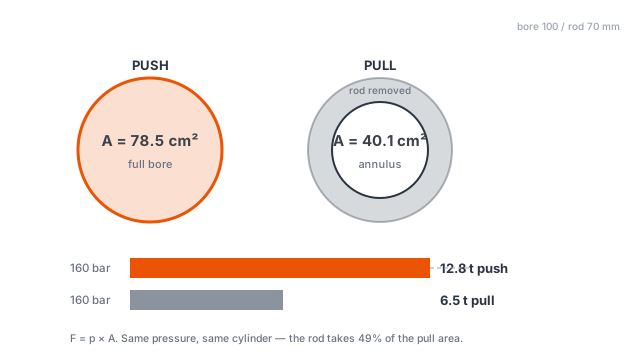
Bore 100 mm gives a piston area of:
A = π/4 × 100² = 7,854 mm² = 78.54 cm²
At 160 bar, which is 16 N/mm², the push force is 7,854 × 16 = 125,660 N, or 12.8 tonnes.
The 70 mm rod removes area from the annulus side. Rod area is π/4 × 70² = 3,848 mm², so the effective pull area is 7,854 − 3,848 = 4,006 mm², and the pull force at the same pressure is 4,006 × 16 = 64,100 N, or 6.5 tonnes.
That ratio, 125.7 / 64.1 = 1.96, is the single most misread number on the sheet. Nearly 2:1 means the cylinder retracts at twice the speed it extends, at a given flow. On a circuit with a fixed-displacement pump and no flow control, that asymmetry is designed in, not adjustable. If your machine needs symmetric speed, you specify a through-rod cylinder or you accept a larger pump.
Stroke and speed
Stroke 500 mm at 20 L/min. Flow is 20,000 cm³/min, area is 78.54 cm², so extension speed is 20,000 / 78.54 = 254.7 cm/min, which is 2.55 m/min. Full extension takes 500 / 254.7 = 1.96 seconds.
Retraction, on 4,006 mm² = 40.06 cm², runs at 20,000 / 40.06 = 499 cm/min, or 4.99 m/min — the same 500 mm in 1.0 second.
Now check the port. A typical SAE-8 port has a flow diameter around 12.7 mm, area 1.27 cm². At 20 L/min the oil velocity through it is 20,000 / 1.27 = 15,748 cm/min = 2.6 m/s, which is fine. Push the same cylinder at 60 L/min and velocity reaches 7.9 m/s. The accepted limits are roughly 1.2 m/s on a suction line, 3 to 4 m/s on a return line and 5 to 6 m/s on a pressure line with a short run. At 7.9 m/s you have built a heat generator and a cavitation source into the port.
The cylinder speed calculator runs these two speeds from bore, rod and flow if you want to try your own numbers before signing the order.
This is why the port column is not a footnote. Doubling speed is a pump decision and a port decision, and the datasheet will tell you the port is -8 while the flow column quietly assumes you checked.
Closed length: the number that decides whether it fits
Stroke is not the installed length. Closed length for a 500 mm stroke single-stage cylinder is typically stroke plus 200 to 260 mm of end-cap, gland and pin allowance, so roughly 700 to 760 mm pin to pin. The datasheet gives the exact figure and it is the one that must match your envelope.
Two traps live here:
Cushion length is usually inside the stroke. A cylinder with a 25 mm cushion at each end delivers 500 mm of stroke with the last 25 mm of each direction slowed. If you need 500 mm of usable travel at full speed, specify 550 mm of stroke.
Closed length tolerance compounds with mounting wear. A ±2 mm tolerance on the cylinder plus 3 mm of worn pin bore plus 2 mm of chassis flex is 7 mm of slop, which on a long cylinder shows up as side load, and side load is what kills rod seals.
A datasheet written for one market will say 160 bar, another will say 2 320 psi, and they are the same cylinder. The unit converter exists because that conversion is done badly more often than any other in this industry.
Pressure: three numbers, one of them real
A datasheet typically lists working pressure, test pressure and sometimes burst pressure.
- Working pressure is the rating you design to.
- Test pressure is usually 1.5 × working, held once, at room temperature, on a new cylinder. It proves the cylinder did not burst that day. It says nothing about fatigue.
- Burst pressure is often 4 × working for industrial construction. That is the margin against a single catastrophic event, not a licence to run at working pressure with shock loads on top.
If your circuit has a relief valve set at 180 bar and the cylinder is rated 160 bar working, the cylinder will survive because the relief never opens. If the relief is set at 210 bar and spike transients reach 260 bar on every reversal, a 160 bar cylinder is being asked to survive at 1.6 × rating, repeatedly. Specify the working pressure against the relief setting plus the transient, not against the nominal system pressure.
The three columns that are usually missing
Seal material. Almost never printed. It decides fluid compatibility and temperature limit, and it is the most common cause of early failure. If it is not on the sheet, ask.
Rod surface specification. “Hard chrome plated” is not a specification. You want the plating thickness (20 to 30 µm is typical for industrial, more for marine) and the substrate hardness, because the chrome does the wearing and the substrate does the load carrying.
Mounting orientation and port rotation. Not a column at all, but a degree figure on the drawing. A cylinder with the ports on the wrong face is a cylinder that does not install, and it is not a manufacturing defect — nobody said otherwise.
Reading a multistage datasheet
Telescopic cylinders list each stage separately, largest first. A three-stage front-mount might read 158 / 136 / 115 mm bore with 4,200 mm total stroke, and 1,918 mm closed length.
Three things follow from those numbers:
- Stage stroke is total stroke divided by the number of stages, less a small overlap per stage. Here roughly 1,400 mm each.
- Force falls as the cylinder extends, because the active area falls. At 160 bar: 158 mm gives 31.6 t, 136 mm gives 23.4 t, 115 mm gives 16.7 t. The last stage delivers 53 % of the first.
- The largest stage extends first, which is what makes telescopics work on a tipper: maximum force at the start of lift, when the load is worst, and minimum force at the top, when the body is nearly over centre.
A datasheet that quotes only “158 mm bore, 4,200 mm stroke” for a multistage cylinder has told you the best case and hidden the worst one.
Checking the sheet against the cylinder that arrives
The datasheet is a promise about a cylinder you have not received yet. Four checks take five minutes and catch most discrepancies:
- Measure retracted pin-to-pin before installation, and compare it to the sheet including its stated tolerance. A cylinder that is 5 mm long does not “wear in”; it loads the mounting.
- Check the rod diameter with callipers, not from the label. On a long-stroke cylinder this is the single dimension most worth verifying, because it sets buckling capacity and it is the one nobody can see from outside.
- Verify the port thread with a gauge before the hose is made up. An adapter is a leak point and an envelope change.
- Ask for the pressure test certificate, and check what pressure it was held at and for how long. Every cylinder should be tested; not every supplier tests every cylinder.
If the certificate is missing, the datasheet is a description of a design, not a record of a part.
What to check before you accept a sheet
| Column | Question to ask |
|---|---|
| Bore / rod | Does the pull force actually meet the load, or only the push force? |
| Stroke | Does it include the cushion length? |
| Closed length | Does it fit, with tolerance, with worn pins? |
| Working pressure | Is it above the relief setting plus transient spikes? |
| Port size | What is the oil velocity at my actual flow? |
| Seal material | Stated, or assumed? |
| Rod spec | Plating thickness and substrate hardness, or just “chrome”? |
| Temperature range | Does it cover the fluid in my machine, not just mineral oil at 20 °C? |
A datasheet is a list of promises. Half of them are about fitting, and half are about lasting. The fitting half is printed in bold; the lasting half is usually the part you have to ask for.