
Renewable energy is often described as a growth market for hydraulics. The accurate version is narrower: hydraulics lost the photovoltaic tracker market and kept the wind pitch market, and the reasons are worth understanding before specifying anything.
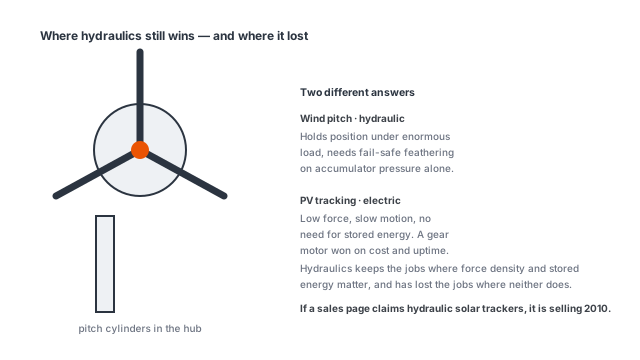
Why PV trackers went electric
A photovoltaic tracker moves once every few minutes and holds a position for the rest of the day. That duty cycle rewards a worm gear and a brake: no oil, no seals, no leakage, and a holding torque that costs nothing while static.
Three hydraulic disadvantages show up in the field. Continuous holding pressure creeps past the piston seal, so the tracker drifts off its set angle over a day. Oil in a desert enclosure reaches 70 to 80 °C and ages at double speed. And a leak on a tracker 3 metres above a solar array is a maintenance call that requires the row to be isolated.
Electric slew drives do not have those problems, which is why almost every new utility-scale PV plant is electric. Concentrated solar power is the exception: a parabolic trough or heliostat row is a single structure carrying real wind load, and one hydraulic actuator can drive a whole row through a linkage, which is a force-density argument electric actuators do not win.
Wind pitch: the fail-safe requirement
A wind turbine pitch system has one requirement that shapes the whole design: after a power loss, the blades must feather. If they do not, the rotor overspeeds, and the consequences are not recoverable.
Hydraulic pitch satisfies this with an accumulator. The pump charges a bladder accumulator during normal operation, and a dump valve releases that stored energy to feather the blades regardless of whether the pump or the grid is available. The accumulator has to hold enough energy for one full feathering stroke at the lowest operating temperature, which is normally the sizing case rather than the pitch force.
Working pressure is typically 100 to 250 bar. The cylinders sit in the hub, so mass matters: a three-cylinder pitch system on a 3 MW turbine is a few tens of kilograms of cylinder per blade, and every kilogram there is rotating mass that the blade root has to carry.
The cylinders that fit
Pitch cylinders are short-stroke, high-force and compact, usually custom. Where the application is instead a positioning function, the standard range applies: the HSG family covers 430 to 3,500 mm of stroke at 20 MPa with bore and rod from 50/28 to 200/140 mm.
Two renewable applications do land inside the standard range. Nacelle and blade lifting during erection is a long-stroke, moderate-force lift, which is HSG territory. Tracker row actuation on CSP is a shorter stroke against a wind load, which suits a 63 to 100 mm bore.
Where there is no grid connection at the actuator, the DC hydraulic power unit covers 12 V or 24 V, 0.75 to 8 cc/rev, 3 to 25 L/min, 3 to 16 L reservoirs and 50 to 250 bar. A heliostat field with a DC unit per row is a real configuration: wireless control, no trenching, and a reservoir small enough to sit inside the pedestal.
The specification points that decide life
Three things separate a renewable-energy cylinder from an industrial one.
Temperature range. A desert tracker sees -5 to 80 °C; a wind nacelle sees -30 to 60 °C. Seal material and fluid viscosity have to work at both ends, and a standard NBR seal at -30 °C will leak on start-up.
Duty cycle honesty. A pitch system runs 200,000 small movements a year, most of them a few millimetres. That is a seal wear regime dominated by small oscillations rather than full strokes, and it is the reason pitch cylinders use a different seal geometry from a tipper cylinder.
Maintenance access. A hub cylinder is reached by climbing. Every part that could be specified as serviceable from outside the hub should be, because the labour cost of a seal change exceeds the part cost by an order of magnitude.
What to send
Application, temperature range, strokes per year, whether fail-safe operation is required and the mass budget. Those five answers decide whether a standard model fits or the cylinder is a custom design.