
Conveyors are electrically driven and hydraulically assisted. Understanding which functions belong to which side of that line is most of the engineering decision.
The four functions that belong to hydraulics
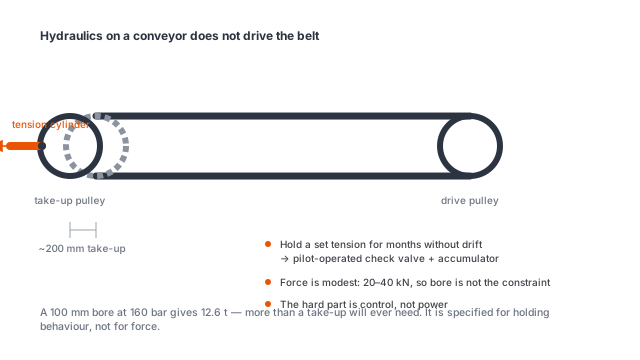
Belt take-up. A gravity take-up tower needs vertical space that mobile plants do not have, and a screw take-up has to be adjusted with the belt stopped. A hydraulic take-up cylinder with an accumulator holds tension under load, can be adjusted from a control panel and gives slightly when a lump passes the belt, which removes one of the main causes of belt splice failure.
Radial stacker raise and lower. This is a long-stroke, low-speed lift against a heavy boom. The HSG family covers 430 to 3,500 mm of stroke at 20 MPa with bore and rod from 50/28 to 200/140 mm, which is the right shape for a stacker lift cylinder: long stroke, moderate force, and a rod sized for bending rather than buckling.
Mobile chassis and axle levelling. A tracked or wheeled crushing plant has to be levelled before the conveyor will track. Four short-stroke cylinders with a common manifold do this in seconds, and the circuit is the same one used on outriggers.
Plough, tripper and diverter positioning. Intermittent, high-force, dirty. An electric actuator in this position needs a gearbox and a brake; a cylinder needs a valve.
Why the drive stays electric
A hydraulic motor driving a conveyor belt is a real option on mobile and underground equipment, mainly because it tolerates stall, gives stepless speed control and survives being sprayed with slurry. On a fixed plant it loses on every metric that matters: overall efficiency, oil cooling in a hot plant, hose runs of 50 metres, and the maintenance cost of a circuit that nobody inspects.
The practical rule is that if the conveyor moves, hydraulics can drive it; if it does not move, the gearmotor wins.
Sizing the take-up
Take-up force is set by the drive, not by the belt. The belt must not slip on the drive pulley at full load, which sets a minimum slack-side tension; the take-up holds 1.5 to 2 times that minimum so that a transient does not drop the belt below the slip threshold. On a 1,000 mm belt carrying 1,000 t/h, that lands in the tens of kilonewtons.
At 160 bar, a 100 mm bore gives 126 kN, which is 12.8 t, and a 125 mm bore gives 196 kN, or 20 t. Both are ordinary cylinder sizes, which is the point: the take-up is not a demanding hydraulic application, it is a demanding control application. The cylinder has to hold a set tension for months without drifting, so the circuit needs a pilot-operated check valve and an accumulator, not just a directional valve.
Contamination is the real risk
Conveyor transfer points are the dustiest place on any plant. A take-up cylinder sits at the tail end, directly under the loading point in many layouts, and the rod is exposed for its full stroke.
Three things make the difference. A bellows boot over the exposed rod, which is cheap and often omitted. A double wiper, so the first lip takes the abrasive and the second seals. And mounting the cylinder rod-down where the geometry allows, so dust falls off the rod rather than settling on it. That last one is free and is routinely missed.
DC power where there is no power
Mobile conveyors, ship loaders and trailer-mounted stackers often have no three-phase supply at the point of use. The DC hydraulic power unit covers 12 V or 24 V, 0.75 to 8 cc/rev, 3 to 25 L/min, 3 to 16 L reservoirs and 50 to 250 bar, with cable or wireless control.
A stacker raise is an intermittent function, so a DC unit sized for the raise time rather than the flow works well: 16 L of reservoir and 6 cc/rev will raise a boom in 30 to 40 seconds and then rest. A take-up, by contrast, runs continuously and needs the cooler and the larger reservoir.
What to send
Belt width, throughput, drive power, take-up travel and whether the plant moves. Those five answers separate the four hydraulic functions above and size each one without a site visit.